Sunday, February 5, 2017

Ethics Assignment

SPOILER ALERT. My post will be talking about a situation that occurred in the show Mr. Robot but also does occur in real life. So here's my warning now for spoilers. Also watch the show. It's really good. 

Situation: In episode 1 (eps1.0_hellofriend.mov) of Mr. Robot the main character of the show Elliot hacks a restaurant owner who facilitates the distribution of child pornography and turns him in to the police. Elliot has faces a lot of inward problems like social anxiety, depression, and other complex psyche issues. He also faces a lot of outward problems such as faults in capitalism, social media, and even directly correlates retail and consumerism as a form of sedation. Things he sees as various ills in society. While Elliot cannot do much to change problems within himself he takes it into his own hand to correct the wrongs in what is his outwards problems in society.

Claim: Elliot and hackers alike are completely fine to target predators, child porn distributors, etc. If they have reason to believe a person in engaging in those acts they should investigate and ultimately hack them to turn them into the police if so need be.

Argument: I'm all for privacy. Every human deserves the right to privacy but when you cross the line, to me at least, you're less than human. A key point I made earlier was that a hacker needs to have reason to believe, as in seeing the traffic, noticing patterns, and ultimately knowing who it is they're hacking before the hacking occurs. After sufficient evidence they give up their rights to privacy and deserve to be hacked. There are various laws against intrusion with computers but this law should not apply to hackers who reveal and turn in child porn distributors and such. 

Principle: If Elliot (and hackers) are not harming or incriminating innocent people then justice should not judge against them for their mode of operation. 

Social Engineering Task #2

My task was to get someone to let me cut them in line. My task was ultimately successful.

In order to execute my task I specifically waited until I was in a store that does not have a huge line at the checkout (typically). A Walgreens worked just fine. I grabbed a drink from the fridge while I waited until about two people were in line. This didn't take long. I pulled my phone out and opened the Uber app. I then left the Uber app on the map screen. Just about when the first person was done ringing out I asked the second person in line "Is it alright if I go ahead of you really quick? My Uber is right outside waiting for me" as I quickly showed them my Uber app that was only on the map screen. Quick enough that they didn't notice I didn't have a ride requested but slow enough that it is the recognizable Uber app or if they don't know what the app is like they at least saw cars and a map. They let me in front with no hesitation. Paid for my drink and booked it out the store as if I went to go catch that Uber.

Setting false pretenses into tricking someone to be compliant. In a real life situation a person could apply these techniques by creating a false sense of urgency for a victim to react. My reasoning for using the Uber app trick was that it made it seem "urgent" which prompted the person to give a quicker response than if I had just asked a normal question. Given the weight of my "urgency" along with the simplicity of my request my victim almost instinctively agreed.

It can be alarmingly easy to create a fake scenario where a person can press a victim into performing actions that would be against their best interest. A good way someone would perform these actions can be someone who wants to plan a surprise party. Condition and create a false pretense that everything is normal for that day while the person who is being lead to the surprise party unsuspectingly goes along with it. A morally wrong way of performing these actions would be to exploit people directly. Call someone with iPhone and let them know that "Your iTunes account has been compromised. Please verify your account login and password or it will be immediately locked." The false pretense along with the urgency is there. Quite a lot of people would fall for this easily and not give it a second thought as to what they're doing.

Friday, February 3, 2017

Social Engineering Task #2


My task was to find a stranger's phone number. What I did is go onto yellow pages online. I clicked to find a person and did it by name. I put a common first name and last name in. I got a list of people. I took the first one to post here and covered the last name, end of address, and last 4 digits of the number to be safe for the person's privacy.

People could use this to find victims of reverse social engineering, as well as to get information to steal more information to steal their identity.

I personally think it is wrong to have someone's personal information out there where anyone can get access to it. If I can find a stranger's address and number and get directions to their place, any basic stocker or identity thief can get that for anyone which is wrong because that goes towards harassing and stealing.

Thursday, February 2, 2017

social engineering task#1

my task was to get someone to tell me what was on their card. I pretended to show displeasure with my task openly in hopes of arousing the curiosity of my classmates. luckily a class mate saw me and offered a trade. of course i asked what was in his card first before a trade could be discussed but he wouldn't reveal what was on his card. i walked away and noted he walked with me as i left the classroom. as we walked down the hall he pressed more for a trade saying i wouldn't have to do anything extra. i could tell he really wanted to trade his card which gave me plenty of room to press for what the card said thereby finishing my task. as we got to the parking lot i asked what was in the card while citing that no one was around to hear. finally we worked it out and he showed me what was on his card which was to get someone to trade with him. Seeing the mutual benefit in the trade i accepted and we both completed our tasks. i took advantage of his willingness to keep pressing knowing that the time limit for his trade would end once i got in my car. Today in a society where self gratification is at an ll time high, people are willing to trade and give a little more for the convenience of expediency. why wait in line at a bank when you can go to the ATM?, why cook when you can order out?. i can see how this can lead to hacking and how people would negotiate more freely to obtain things.

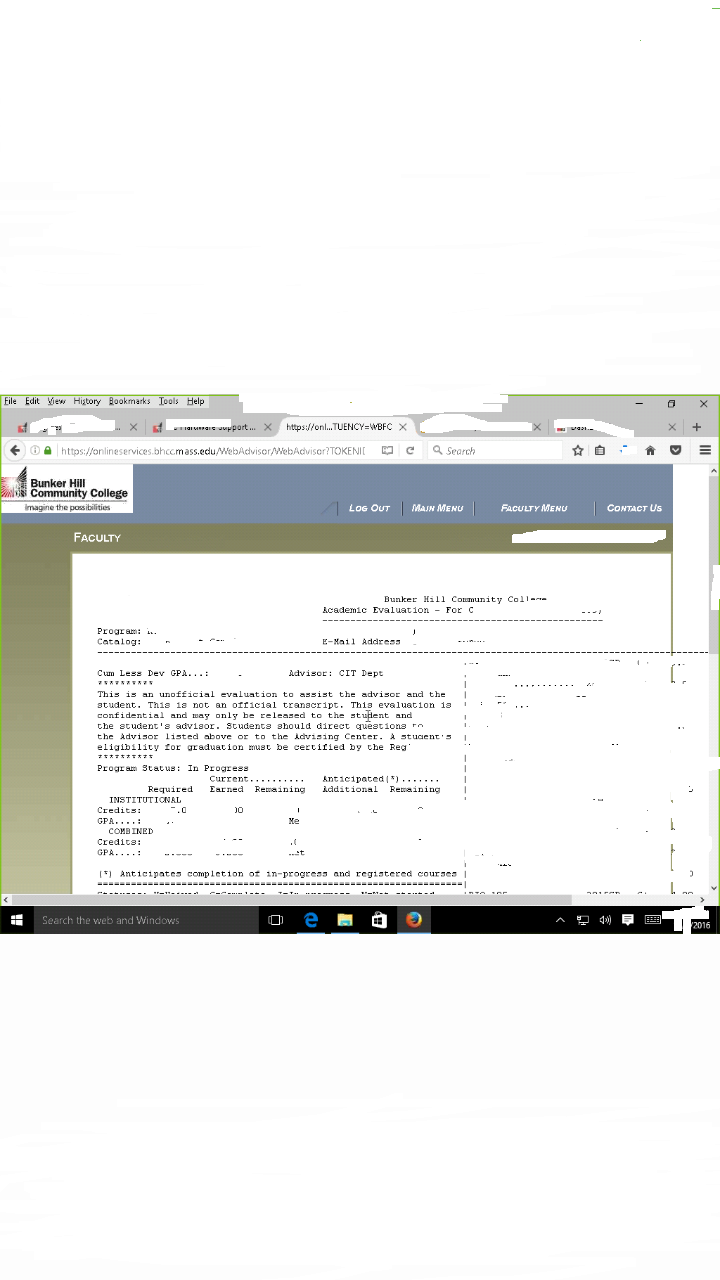
Getting a fellow classmmate's program evaluation


My ethical hacking task was to basically get a BHCC student to show me their program evaluation in Web Advisor or Portal; however, i have used a method which i am not sure if it is legal or ethical or illegal and unethical, last semester i had recorded all of my classes' meetings to use a reference if i need to listen to any lecture again, our professor wanted to demonstrate a change of program, he then processed to ask if any student wanted to volunteer and open their BHCC advisor and then share their screen with the other classmates using Webex , i am bad i know :D


Hacker Identity

My ethical hacking task was to identify a hacker identity using Google and any other social media site, given the fact that i had access to this blogger after professor Monica came back from Africa and lectured last class, i could not accomplish my task on time; however, this was very helpful to me as i could easily identify a hacker identity simply by asking them about their task that they have been assigned to do, i then processed to the blogger and read all of the tasks to finally come across their ask and found their ethical techniques to resolve their task. I am not sure if i should their identity here or not, but i will gladly do that if needed.